Serious investors evaluating automated coffee business opportunities want clear, data-driven answers on revenue potential. In 2026, the intelligent vending and smart kiosk market is projected to reach $17.7 billion globally, growing at an 11.6% CAGR through 2036. Within this expanding sector, smart coffee kiosks stand out for their ability to generate predictable, location-based income with minimal daily owner involvement.
From our direct experience supporting investors in deploying these systems across high-traffic commercial venues, revenue per location varies significantly based on foot traffic, venue type, and operational execution. This analysis draws on aggregated operational data from multiple installations in 2025–2026 to provide realistic benchmarks. It focuses on what investors can expect when placing a premium automated coffee kiosk in the right environment.
From our direct experience supporting investors in deploying these systems across high-traffic commercial venues, revenue per location varies significantly based on foot traffic, venue type, and operational execution. This analysis draws on aggregated operational data from multiple installations in 2025–2026 to provide realistic benchmarks. It focuses on what investors can expect when placing a premium automated coffee kiosk in the right environment.
Daily Sales and Customer Volume Drivers
Daily sales form the foundation of revenue per location. In well-chosen commercial settings, a single smart coffee kiosk typically processes 50–120 transactions per day, depending on the venue.
Key factors influencing customer volume include:
Real operational data shows:
These volumes reflect consistent daytime demand where people need quality beverages without long waits. Higher customer volume directly correlates with stronger revenue metrics.
To see which venue types deliver the strongest daily sales, review our guide on the best locations for starting a smart coffee bar.
Key factors influencing customer volume include:
- Peak daytime foot traffic (morning and afternoon rushes)
- Captive audience in offices, hospitals, universities, or gyms
- Convenience factor — quick, contactless service appeals to busy professionals
Real operational data shows:
- University campuses: 75–95 cups/day average
- Hospitals/medical centers: 65–85 cups/day
- Large office buildings: 55–75 cups/day
- Fitness centers: 45–65 cups/day
- Shopping mall high-traffic zones: 90–120 cups/day
These volumes reflect consistent daytime demand where people need quality beverages without long waits. Higher customer volume directly correlates with stronger revenue metrics.
To see which venue types deliver the strongest daily sales, review our guide on the best locations for starting a smart coffee bar.
Revenue Metrics and Profit Analysis Per Location
Revenue per location breaks down simply once daily volume is established.
Using realistic averages:
Using realistic averages:
- Average selling price per drink: $4.00–$4.20
- Cost per drink (supplies + royalty): $1.00–$1.20
- Net profit per drink: $2.80–$3.00
This creates strong monthly revenue metrics:
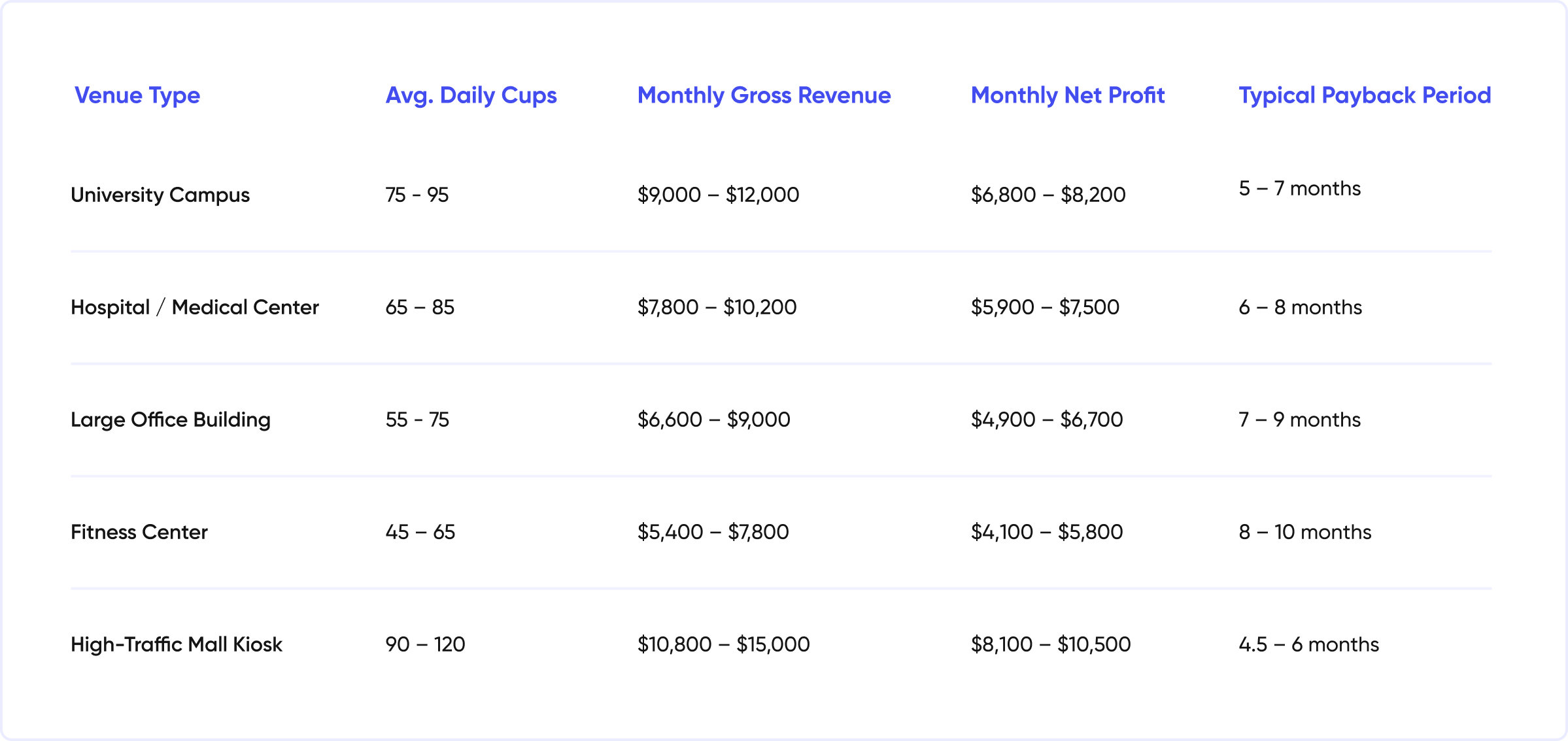
These figures are derived from aggregated real performance data across multiple sites. The highest-performing locations combine strong foot traffic with extended operating hours, allowing the kiosk to capture revenue throughout the day.
For a broader perspective on how these revenue metrics fit into modern investment strategies, explore unattended retail opportunities
For a broader perspective on how these revenue metrics fit into modern investment strategies, explore unattended retail opportunities
Building Recurring Revenue with Smarter Systems
The strongest appeal of these smarter alternatives lies in their ability to generate reliable recurring revenue. Once properly placed, units operate independently, producing steady income with minimal ongoing effort. Investors can start with one or two units and scale to multiple locations while maintaining the same low daily time commitment.
This structure creates genuine semi-passive income streams that compound over time. Many partners begin in a single high-traffic venue and expand regionally, building a portfolio that delivers attractive cash flow without the operational headaches of traditional vending franchises.
To explore practical ways to build this type of recurring revenue, review our guide on semi-passive coffee business ideas for serious investors
This structure creates genuine semi-passive income streams that compound over time. Many partners begin in a single high-traffic venue and expand regionally, building a portfolio that delivers attractive cash flow without the operational headaches of traditional vending franchises.
To explore practical ways to build this type of recurring revenue, review our guide on semi-passive coffee business ideas for serious investors
Foot Traffic Impact on Per Location Income
Foot traffic remains the single biggest driver of per-location income. Locations with steady, predictable daytime crowds outperform sporadic or seasonal spots.
In high-traffic commercial environments, the kiosk benefits from:
Real examples show that moving from a moderate-traffic office (55 cups/day) to a high-traffic university or mall (95+ cups/day) can increase monthly net profit by 40–60%. This foot traffic impact makes location selection one of the highest-leverage decisions for maximizing returns.
In high-traffic commercial environments, the kiosk benefits from:
- Captive audiences who value speed and convenience
- Repeat customers who return daily or weekly
- Extended hours (24/7 potential) that capture off-peak demand
Real examples show that moving from a moderate-traffic office (55 cups/day) to a high-traffic university or mall (95+ cups/day) can increase monthly net profit by 40–60%. This foot traffic impact makes location selection one of the highest-leverage decisions for maximizing returns.
Automation Results and Operational Efficiency
The technology behind these systems directly supports strong revenue metrics. Automated cleaning cycles, predictive maintenance alerts, and real-time inventory tracking keep the kiosk running reliably with minimal owner time — typically 15–30 minutes per day.
Cashless payment integration consistently lifts average transaction values by 30–37%. Remote analytics allow owners to optimize menus and pricing based on actual customer volume patterns, further improving per-location income over time.
These automation results create a virtuous cycle: reliable operation leads to higher customer satisfaction, which drives repeat business and stronger revenue.
To understand how food and beverage automation contributes to these outcomes, see our overview of automated food & beverage business opportunities
Cashless payment integration consistently lifts average transaction values by 30–37%. Remote analytics allow owners to optimize menus and pricing based on actual customer volume patterns, further improving per-location income over time.
These automation results create a virtuous cycle: reliable operation leads to higher customer satisfaction, which drives repeat business and stronger revenue.
To understand how food and beverage automation contributes to these outcomes, see our overview of automated food & beverage business opportunities
Building Scalable Income Through Multiple Locations
Once a single location proves successful, the model scales efficiently. Many investors start with one kiosk and expand to 3–5 units within 12–18 months, using the same remote monitoring platform to oversee everything.
This approach multiplies per location income without multiplying daily effort. Centralized data and repeatable operations allow owners to manage a growing portfolio while maintaining a low daily time commitment.
For practical examples of building this kind of scalable income, review our guide on semi-passive coffee business ideas
This approach multiplies per location income without multiplying daily effort. Centralized data and repeatable operations allow owners to manage a growing portfolio while maintaining a low daily time commitment.
For practical examples of building this kind of scalable income, review our guide on semi-passive coffee business ideas
Why Touch Coffee Delivers Strong Revenue Performance
Touch Coffee has built a reputation for consistent, data-backed results through its smart coffee kiosk systems. At Touch Coffee, you will find transparent details on the Standard and Premium models, real location performance examples, and tools to project potential revenue in your target markets.
The systems emphasize commercial-grade reliability, remote management, and ongoing support — all designed to maximize per location income while keeping operations simple and low-maintenance. For a forward-looking view of the unattended retail category, read our analysis of the unattended retail coffee business.
The systems emphasize commercial-grade reliability, remote management, and ongoing support — all designed to maximize per location income while keeping operations simple and low-maintenance. For a forward-looking view of the unattended retail category, read our analysis of the unattended retail coffee business.
Comparison: Revenue Potential by Model Type

Smart coffee kiosks consistently outperform basic vending in revenue metrics while requiring far less daily effort than staffed operations.
Frequently Asked Questions
What is the most important factor for maximizing revenue per location?
Foot traffic in high-traffic commercial venues is the biggest driver. Strategic placement in universities, hospitals, offices, or malls delivers the strongest results.
Foot traffic in high-traffic commercial venues is the biggest driver. Strategic placement in universities, hospitals, offices, or malls delivers the strongest results.
How quickly can a smart coffee kiosk reach profitability?
In optimal locations, payback typically occurs within 5–9 months, after which the monthly net profit becomes highly attractive with minimal ongoing costs.
In optimal locations, payback typically occurs within 5–9 months, after which the monthly net profit becomes highly attractive with minimal ongoing costs.
Can multiple kiosks be managed efficiently?
Yes. Centralized remote monitoring allows owners to oversee several locations with very low daily time commitment, supporting scalable income growth.
Yes. Centralized remote monitoring allows owners to oversee several locations with very low daily time commitment, supporting scalable income growth.
Are these results realistic for new investors?
The model is designed for accessibility. With proper location selection and support, qualified investors consistently achieve the revenue metrics outlined here.
The model is designed for accessibility. With proper location selection and support, qualified investors consistently achieve the revenue metrics outlined here.
Smart coffee kiosks continue to demonstrate strong revenue potential per location in 2026, driven by automation, strategic placement, and growing demand for convenient, high-quality beverages in commercial environments. For serious investors focused on measurable outcomes, these systems offer clear revenue metrics, strong profit analysis, and genuine scalability.
If you are evaluating opportunities that deliver reliable per-location income with low daily effort, we invite you to explore the details.
If you are evaluating opportunities that deliver reliable per-location income with low daily effort, we invite you to explore the details.