Scaling an automated coffee business from one location to multiple units is one of the most attractive aspects of this model in 2026. With the intelligent vending and smart kiosk market projected to reach $17.7 billion this year and grow at an 11.6% CAGR through 2036, investors who master expansion can build substantial semi-passive income portfolios with relatively low additional daily effort.
From our extensive experience guiding investors through successful multi-unit growth, the transition from one kiosk to several is highly achievable when the right systems are in place. The model’s inherent repeatability - compact footprint, remote monitoring, and low maintenance - makes scaling significantly easier than with traditional staffed businesses. This guide walks through exactly how to scale an automated coffee business effectively, from initial planning to managing multiple locations profitably.
From our extensive experience guiding investors through successful multi-unit growth, the transition from one kiosk to several is highly achievable when the right systems are in place. The model’s inherent repeatability - compact footprint, remote monitoring, and low maintenance - makes scaling significantly easier than with traditional staffed businesses. This guide walks through exactly how to scale an automated coffee business effectively, from initial planning to managing multiple locations profitably.
Why Scaling Delivers Strong Revenue Growth
The economics of scaling are compelling. Once a single location proves successful, adding more units leverages the same operational knowledge, supplier relationships, and remote management tools. This creates exponential revenue growth without a proportional increase in owner time.
Key benefits of multi-location scaling include:
Many investors start with one strong-performing kiosk and expand to 4–8 units within 18–24 months, significantly increasing monthly income while keeping daily involvement manageable.
For a broader view of scalable opportunities in this space, explore unattended retail opportunities
Key benefits of multi-location scaling include:
- Diversified revenue streams across different venues
- Improved negotiating power with suppliers
- Centralized monitoring of all units from one dashboard
- Higher overall returns on invested time and capital
Many investors start with one strong-performing kiosk and expand to 4–8 units within 18–24 months, significantly increasing monthly income while keeping daily involvement manageable.
For a broader view of scalable opportunities in this space, explore unattended retail opportunities
Building a Strong Foundation Before Scaling
Successful expansion begins with a proven single-unit model. Investors should focus first on achieving consistent performance in the initial location before adding more.
This includes:
Once a single location is running smoothly with predictable revenue and low maintenance, the business becomes much easier to replicate. Rushing into multiple locations before mastering one often leads to avoidable operational issues.
To learn how to choose the right starting locations, see our guide on the best locations for starting a smart coffee bar
This includes:
- Optimizing placement and foot traffic
- Refining daily routines and maintenance processes
- Understanding local customer preferences through sales data
- Establishing reliable supplier relationships
Once a single location is running smoothly with predictable revenue and low maintenance, the business becomes much easier to replicate. Rushing into multiple locations before mastering one often leads to avoidable operational issues.
To learn how to choose the right starting locations, see our guide on the best locations for starting a smart coffee bar
Expansion Strategy and Multi-Unit Growth
A smart expansion strategy focuses on controlled, profitable growth rather than rapid but risky expansion.
Recommended approaches include:
Centralized remote monitoring is the biggest enabler of multi-unit growth. A single dashboard allows you to track sales, inventory, and performance across all locations in real time, making management efficient even with 5–10+ units.
For practical examples of building scalable income, review our guide on semi-passive coffee business ideas
Recommended approaches include:
- Concentric Expansion - Add units in the same city or region first to simplify logistics and support.
- Venue Type Diversification - Spread risk across offices, universities, hospitals, and malls.
- Phased Rollout - Add one new location every 2–4 months after the previous one stabilizes.
Centralized remote monitoring is the biggest enabler of multi-unit growth. A single dashboard allows you to track sales, inventory, and performance across all locations in real time, making management efficient even with 5–10+ units.
For practical examples of building scalable income, review our guide on semi-passive coffee business ideas
Systemization and Operations Scaling
Systemization is what allows true scalability. Documenting every process - from daily restocking routines to alert response protocols - ensures consistency as you add more locations.
Essential systems to develop include:
Well-systemized operations allow investors to manage multiple locations with less than 1–2 hours per day total, creating genuine semi-passive income at scale.
To understand how automation supports efficient multi-unit operations, read our overview of automated food & beverage business opportunities
Essential systems to develop include:
- Standardized daily/weekly maintenance checklists
- Centralized supply ordering and inventory management
- Clear performance reporting and review processes
- Technician and support escalation procedures
Well-systemized operations allow investors to manage multiple locations with less than 1–2 hours per day total, creating genuine semi-passive income at scale.
To understand how automation supports efficient multi-unit operations, read our overview of automated food & beverage business opportunities
Revenue Growth and Financial Considerations
As you scale, revenue growth typically accelerates due to economies of scale and operational efficiencies.
Many multi-unit operators report:
Financial planning for scaling should include reserving capital for new units, maintaining a buffer for initial months of each new location, and tracking unit-level performance closely.
To explore why low-labour models support efficient scaling, see our insights on low-labour business models
Many multi-unit operators report:
- 20–30% better margins on subsequent units due to bulk purchasing
- Faster payback on additional units (often 4–7 months)
- Improved overall portfolio stability through diversification
Financial planning for scaling should include reserving capital for new units, maintaining a buffer for initial months of each new location, and tracking unit-level performance closely.
To explore why low-labour models support efficient scaling, see our insights on low-labour business models
Why Touch Coffee Supports Easy Scaling
Touch Coffee has designed its smart coffee systems specifically for multi-location growth. At Touch Coffee, you will find advanced remote monitoring tools, standardized processes, and support structures built for investors who want to scale efficiently while keeping operations simple.
The platform emphasizes repeatability, centralized management, and reliable performance across different locations - making it easier to expand confidently. For a forward-looking view of the unattended retail category, read our analysis of the unattended retail coffee business
The platform emphasizes repeatability, centralized management, and reliable performance across different locations - making it easier to expand confidently. For a forward-looking view of the unattended retail category, read our analysis of the unattended retail coffee business
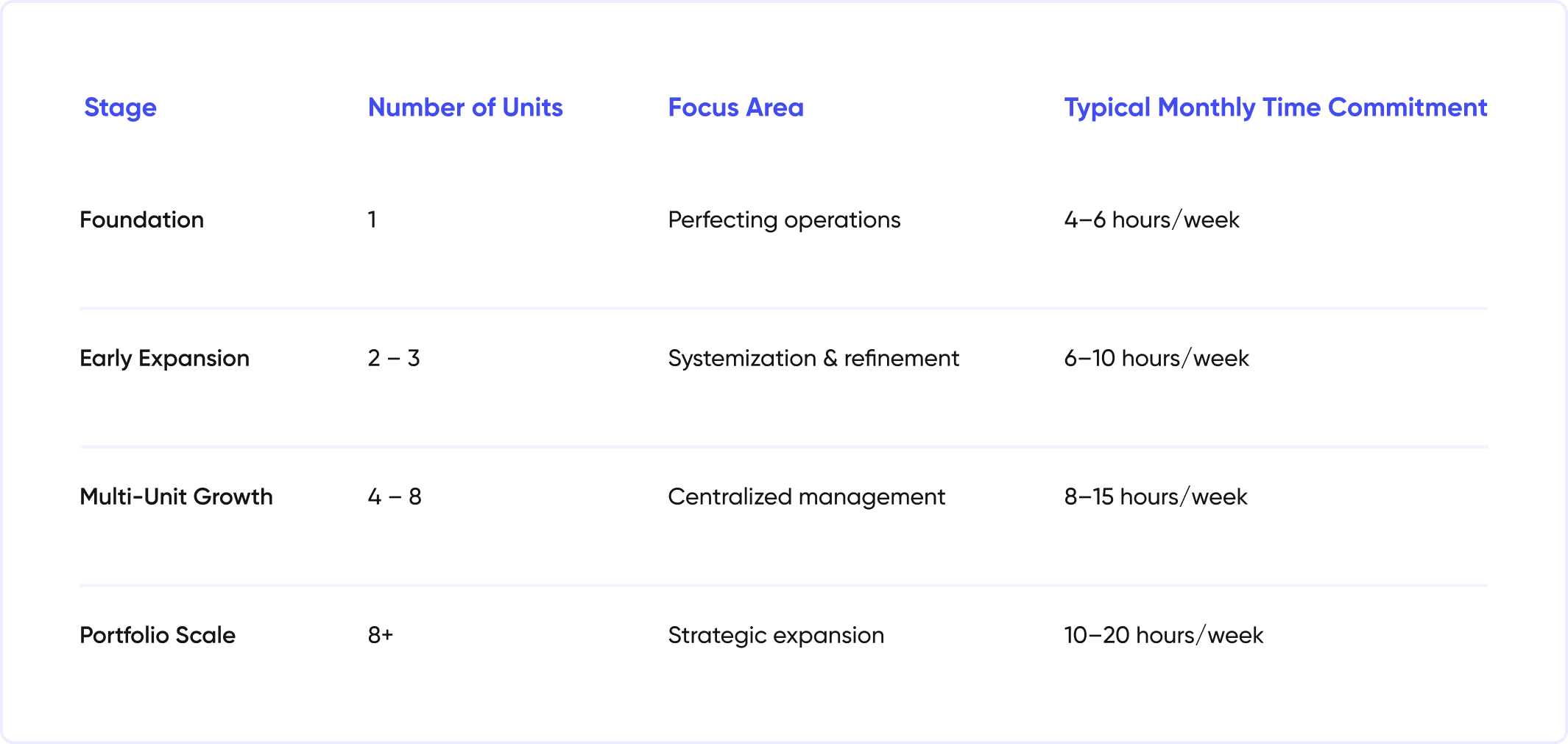
This roadmap shows how time commitment grows much more slowly than revenue as you scale.
Frequently Asked Questions
How many locations can one person realistically manage?
Most investors comfortably manage 6–12 locations with proper systems and remote monitoring in place.
Most investors comfortably manage 6–12 locations with proper systems and remote monitoring in place.
What is the biggest challenge when scaling?
Maintaining consistency across locations. Strong systemization and standardized processes solve this effectively.
Maintaining consistency across locations. Strong systemization and standardized processes solve this effectively.
When is the right time to add a second location?
Once the first unit has been stable and profitable for at least 3–4 months, and all processes are well documented.
Once the first unit has been stable and profitable for at least 3–4 months, and all processes are well documented.
Does scaling improve profitability?
Yes. Bulk purchasing, shared knowledge, and operational efficiencies typically improve margins on additional units.
Yes. Bulk purchasing, shared knowledge, and operational efficiencies typically improve margins on additional units.