Opening a coffee business in 2026 looks very different from what it did even five years ago. The options available to investors today range from the traditional staffed cafe to fully automated, unattended coffee bar systems that operate around the clock with minimal daily involvement. For serious investors evaluating where to deploy capital, the comparison is not simply about coffee — it is about business model efficiency, scalability, and return on investment.
From our experience supporting investors across Canada and the United States, we have seen this question come up repeatedly: Does the traditional cafe model still make financial sense, or has the automated approach fundamentally changed the calculus? This analysis breaks down both models across the metrics that matter most to a serious investor.
From our experience supporting investors across Canada and the United States, we have seen this question come up repeatedly: Does the traditional cafe model still make financial sense, or has the automated approach fundamentally changed the calculus? This analysis breaks down both models across the metrics that matter most to a serious investor.
The Core Difference: A Business Model Question, Not a Coffee Question
Before diving into numbers, it is worth framing the comparison correctly. A traditional cafe is a hospitality business — it requires staff, a physical fit-out, customer service operations, and daily management. An automated coffee bar is a technology-enabled unattended retail asset — it generates revenue independently, scales through replication, and requires only light operational oversight.
These are not two versions of the same business. They are fundamentally different investment vehicles that happen to serve beverages. Understanding that distinction is the starting point for making a clear-headed comparison.
These are not two versions of the same business. They are fundamentally different investment vehicles that happen to serve beverages. Understanding that distinction is the starting point for making a clear-headed comparison.
Startup Investment: What It Actually Costs to Get In
Traditional Cafe
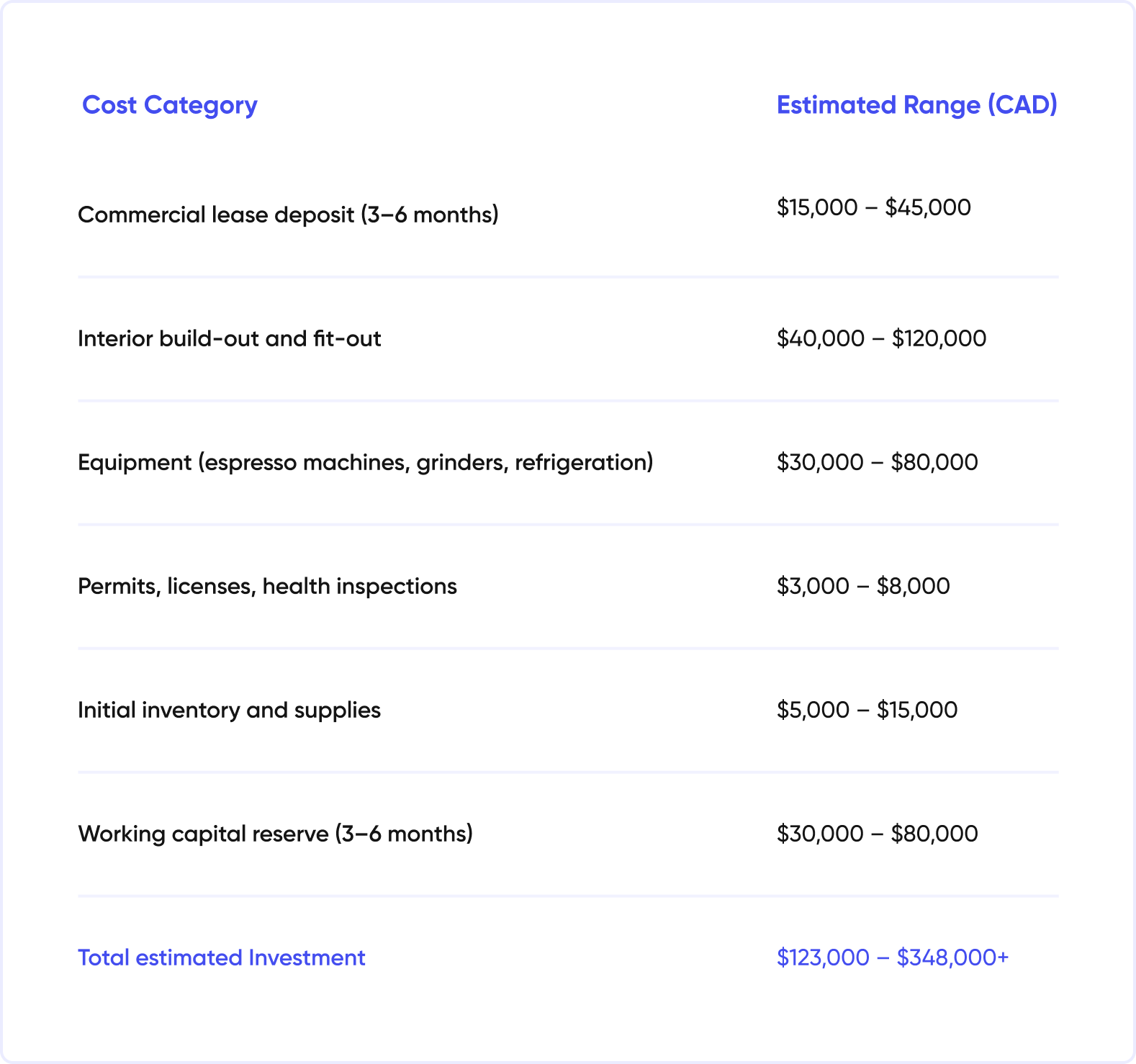
Opening a cafe in Canada in 2026 is a capital-intensive undertaking. According to Square Canada, the cost to open a coffee shop in Canada typically ranges from CA$150,000 to CA$300,000, depending on location, size, and equipment quality. In major urban centres like Toronto or Vancouver, costs can push significantly higher once commercial lease deposits, kitchen build-outs, interior design, equipment, permits, and working capital reserves are factored in.
A realistic breakdown for a mid-sized Canadian cafe includes:
Opening a cafe in Canada in 2026 is a capital-intensive undertaking. According to Square Canada, the cost to open a coffee shop in Canada typically ranges from CA$150,000 to CA$300,000, depending on location, size, and equipment quality. In major urban centres like Toronto or Vancouver, costs can push significantly higher once commercial lease deposits, kitchen build-outs, interior design, equipment, permits, and working capital reserves are factored in.
A realistic breakdown for a mid-sized Canadian cafe includes:
And this is before a single cup is sold.
Automated Coffee Bar
By contrast, a Touch Coffee Smart Bar starts at CA$17,000 for a fully equipped, commercial-grade unit with touchscreen interface, bean-to-cup technology, contactless payment integration, and remote monitoring capability. There is no build-out, no lease fit-out, no ventilation system, no seating to furnish, and no kitchen to install.
The capital requirement differential is stark. An investor can deploy ten automated coffee bar units for the same budget it takes to open a single mid-range cafe in a Canadian city.
By contrast, a Touch Coffee Smart Bar starts at CA$17,000 for a fully equipped, commercial-grade unit with touchscreen interface, bean-to-cup technology, contactless payment integration, and remote monitoring capability. There is no build-out, no lease fit-out, no ventilation system, no seating to furnish, and no kitchen to install.
The capital requirement differential is stark. An investor can deploy ten automated coffee bar units for the same budget it takes to open a single mid-range cafe in a Canadian city.
Labor: The Hidden Cost That Reshapes everything
If startup costs are the entry barrier, labor is the ongoing operational burden that determines long-term profitability — and it is where the two models diverge most dramatically.
Traditional Cafe Labor Realities
Industry benchmarks consistently show that labor accounts for 25–35% of total revenue in independent coffee shops. At those ratios, a cafe generating CA$40,000 per month spends CA$10,000–$14,000 monthly on wages alone — before employer CPP contributions, eI premiums, holiday pay, and staff training costs are added.
The staffing challenge is compounded by turnover. The food service industry in Canada faces annual barista turnover rates in the range of 60–80%, meaning the average barista stays six to twelve months. each departure triggers a new cycle of recruitment, onboarding, and training — a cost that industry estimates place at CA$1,500–$3,000 per employee when factoring in productivity loss.
The 2026 Canadian restaurant industry is under additional pressure: nearly 79% of Canadian restaurant operators report staffing gaps, and immigration policy changes have tightened the labour pool further, according to the TouchBistro 2026 Canadian State of Restaurants Report.
Automated Coffee Bar Labor Reality
An automated coffee bar requires approximately 20 minutes of daily attention — restocking ingredients, basic cleaning checks, and a quick equipment review. There are no employees to schedule, no payroll taxes to remit, no sick days to cover, and no turnover to manage. Remote monitoring via a mobile app means an investor can oversee multiple units from anywhere, at any time.
For investors building a semi-passive income model, this operational simplicity is not a minor convenience — it is a structural advantage that directly protects margin.
Traditional Cafe Labor Realities
Industry benchmarks consistently show that labor accounts for 25–35% of total revenue in independent coffee shops. At those ratios, a cafe generating CA$40,000 per month spends CA$10,000–$14,000 monthly on wages alone — before employer CPP contributions, eI premiums, holiday pay, and staff training costs are added.
The staffing challenge is compounded by turnover. The food service industry in Canada faces annual barista turnover rates in the range of 60–80%, meaning the average barista stays six to twelve months. each departure triggers a new cycle of recruitment, onboarding, and training — a cost that industry estimates place at CA$1,500–$3,000 per employee when factoring in productivity loss.
The 2026 Canadian restaurant industry is under additional pressure: nearly 79% of Canadian restaurant operators report staffing gaps, and immigration policy changes have tightened the labour pool further, according to the TouchBistro 2026 Canadian State of Restaurants Report.
Automated Coffee Bar Labor Reality
An automated coffee bar requires approximately 20 minutes of daily attention — restocking ingredients, basic cleaning checks, and a quick equipment review. There are no employees to schedule, no payroll taxes to remit, no sick days to cover, and no turnover to manage. Remote monitoring via a mobile app means an investor can oversee multiple units from anywhere, at any time.
For investors building a semi-passive income model, this operational simplicity is not a minor convenience — it is a structural advantage that directly protects margin.
Profit Margins and Payback Period
Traditional Cafe Margins
Independent coffee shops typically operate at net profit margins of 5–15%. On CA$40,000 in monthly revenue, that translates to CA$2,000–$6,000 in net monthly profit after all expenses. The breakeven timeline for a traditional cafe typically ranges from 18 months to 3 years in a well-performing location.
Monthly operating costs — rent, utilities, labor, cost of goods, insurance, and marketing — frequently consume 75–85% of monthly sales, leaving a narrow and fragile margin that is highly sensitive to staffing disruptions, rent increases, or seasonal slowdowns.
Automated Coffee Bar Margins
The cost structure of an automated coffee bar looks entirely different. With a selling price of CA$4.00 per drink and a cost per drink of approximately CA$1.50, the net profit per cup is approximately CA$2.50. At 50 cups per day across a single unit, that generates approximately CA$3,750 per month in net income.
Independent coffee shops typically operate at net profit margins of 5–15%. On CA$40,000 in monthly revenue, that translates to CA$2,000–$6,000 in net monthly profit after all expenses. The breakeven timeline for a traditional cafe typically ranges from 18 months to 3 years in a well-performing location.
Monthly operating costs — rent, utilities, labor, cost of goods, insurance, and marketing — frequently consume 75–85% of monthly sales, leaving a narrow and fragile margin that is highly sensitive to staffing disruptions, rent increases, or seasonal slowdowns.
Automated Coffee Bar Margins
The cost structure of an automated coffee bar looks entirely different. With a selling price of CA$4.00 per drink and a cost per drink of approximately CA$1.50, the net profit per cup is approximately CA$2.50. At 50 cups per day across a single unit, that generates approximately CA$3,750 per month in net income.
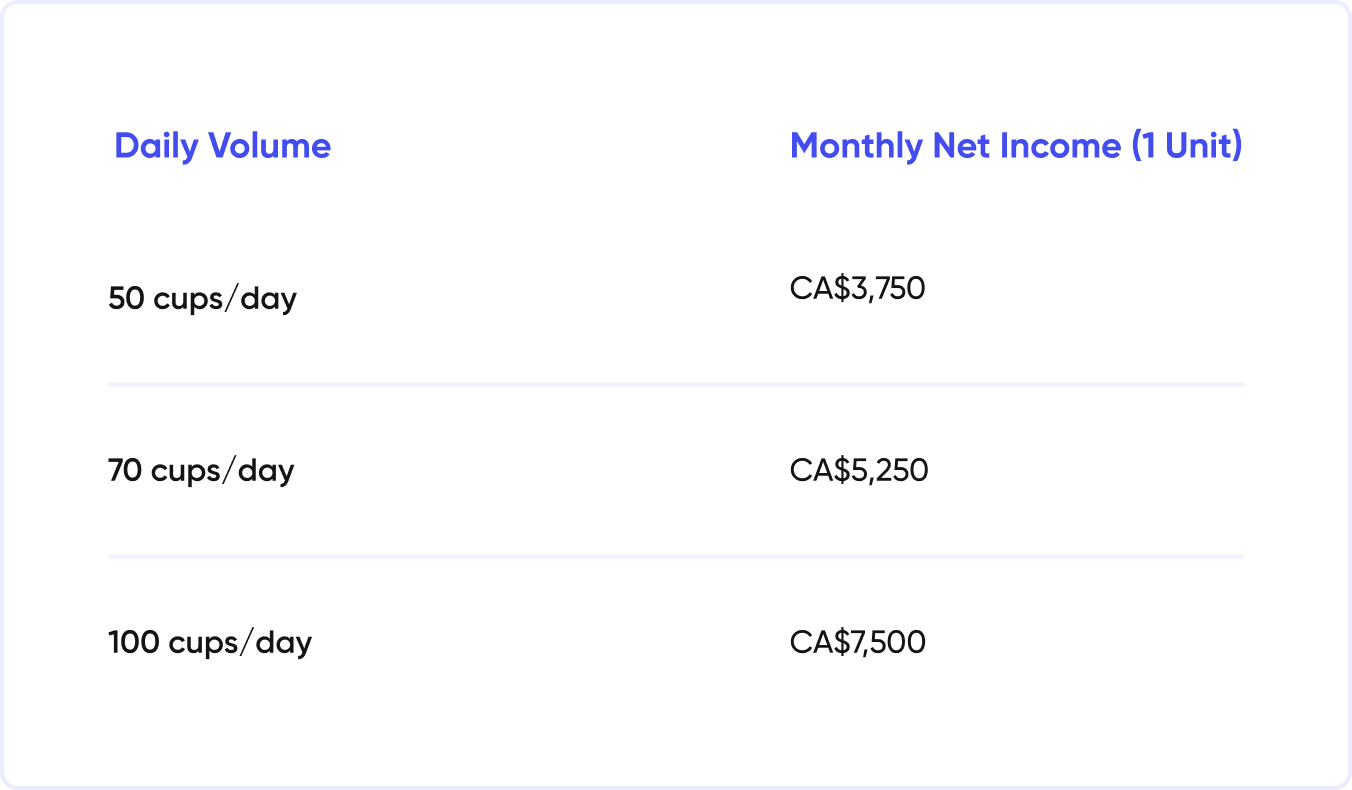
At those returns, a CA$17,000 investment reaches full payback in approximately 5 months at moderate volume — a timeline no traditional cafe model can compete with.
For a broader look at how these revenue figures hold up across different venue types, our detailed analysis of smart coffee kiosk revenue per location provides venue-specific benchmarks from real operational data.
For a broader look at how these revenue figures hold up across different venue types, our detailed analysis of smart coffee kiosk revenue per location provides venue-specific benchmarks from real operational data.
Scalability: The Investor's Core Question
One of the most critical factors for any serious investor is not just how well the first unit performs — it is how quickly and efficiently the model can be replicated.
Scaling a Traditional Cafe
each new cafe location requires a fresh capital injection of CA$150,000–$300,000+, a new long-term lease commitment, a new team to hire and train, and months of build-out and setup before revenue begins. Growth is capital-intensive, time-consuming, and operationally complex. Most independent cafe operators find that managing more than two or three locations becomes a full-time operational burden.
Scaling an Automated Coffee Bar
Adding a second, third, or fifth automated coffee bar unit does not proportionally increase management time. The same mobile app dashboard monitors all units. Restocking logistics are straightforward and can be systematized efficiently. each new unit is a new recurring revenue stream with no additional staffing overhead.
This structural scalability is what makes the automated coffee bar model particularly compelling for investors thinking beyond a single unit. The unattended retail coffee business model is specifically designed for multi-unit portfolio growth — and Touch Coffee partners routinely expand from one to three or more units within 12–18 months.
If you are ready to explore what a multi-unit portfolio could look like for your investment goals, visit Touch Coffee to speak with the team directly.
Scaling a Traditional Cafe
each new cafe location requires a fresh capital injection of CA$150,000–$300,000+, a new long-term lease commitment, a new team to hire and train, and months of build-out and setup before revenue begins. Growth is capital-intensive, time-consuming, and operationally complex. Most independent cafe operators find that managing more than two or three locations becomes a full-time operational burden.
Scaling an Automated Coffee Bar
Adding a second, third, or fifth automated coffee bar unit does not proportionally increase management time. The same mobile app dashboard monitors all units. Restocking logistics are straightforward and can be systematized efficiently. each new unit is a new recurring revenue stream with no additional staffing overhead.
This structural scalability is what makes the automated coffee bar model particularly compelling for investors thinking beyond a single unit. The unattended retail coffee business model is specifically designed for multi-unit portfolio growth — and Touch Coffee partners routinely expand from one to three or more units within 12–18 months.
If you are ready to explore what a multi-unit portfolio could look like for your investment goals, visit Touch Coffee to speak with the team directly.
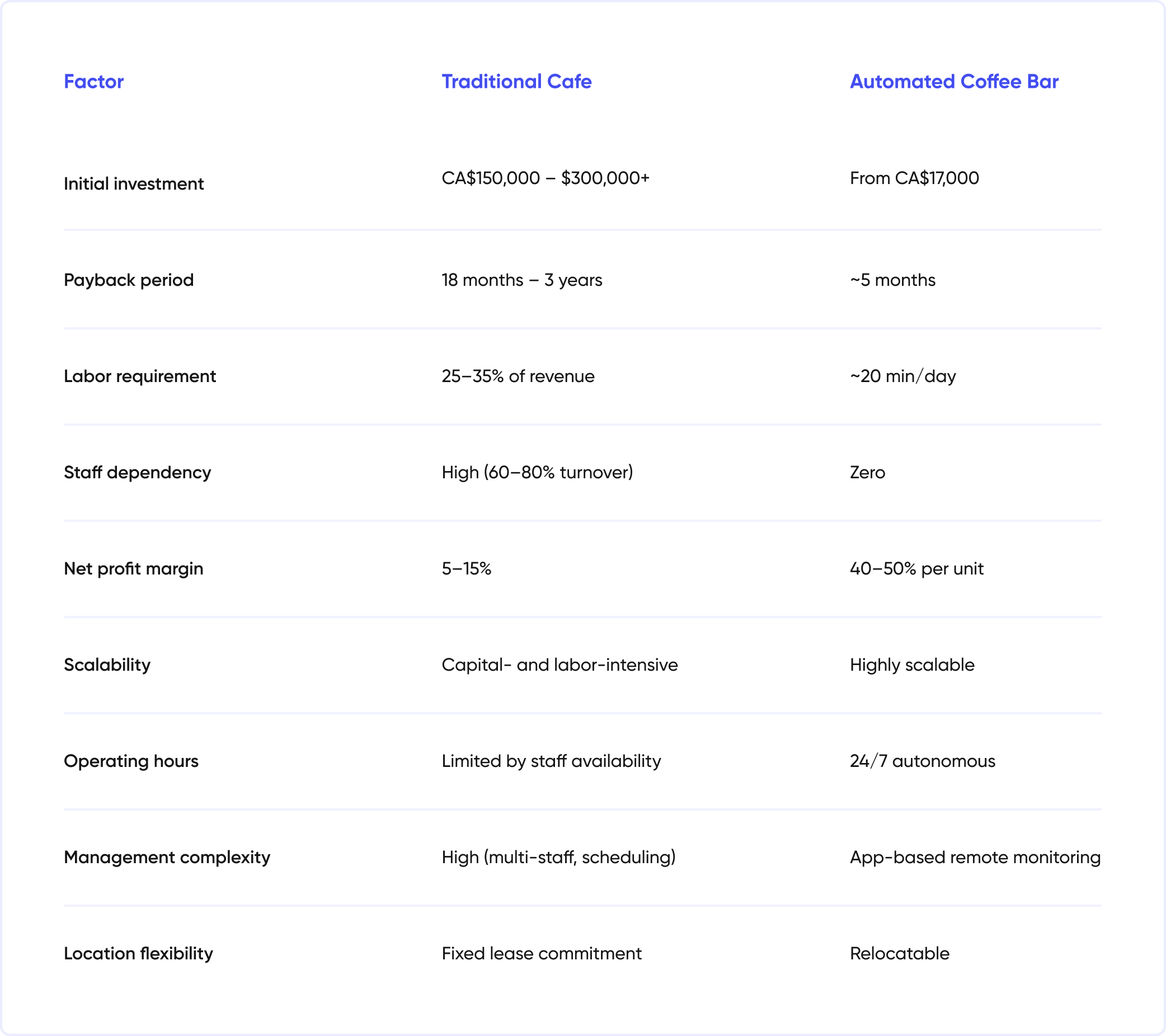
Head-to-Head Comparison
Risk Profile: What Investors Need to Consider
No investment is without risk, and a balanced comparison requires acknowledging the risk profile of each model honestly.
Traditional Cafe Risks
The traditional cafe carries multiple correlated risk factors: high fixed costs through lease commitments, revenue that is entirely dependent on staffing consistency, sensitivity to neighborhood foot traffic changes, and narrow margins that leave little buffer for disruption. The 2026 Canadian labour market has made these risks more acute, not less.
Automated Coffee Bar Risks
The primary risks in the automated model are location selection and machine uptime. A poorly chosen site with insufficient foot traffic will underperform regardless of how good the equipment is, which is why location strategy is the highest-leverage decision an operator makes. Machine downtime, while manageable through remote diagnostics and the manufacturer's warranty and support, can temporarily interrupt revenue at a given unit.
The risk mitigation comes from two sources: the support infrastructure that comes with a reputable operator like Touch Coffee, and the ability to relocate a unit if a location underperforms — something a cafe lease simply does not allow.
For investors who want to understand how to evaluate and mitigate location risk before placing a unit, our guide on the best locations for starting a smart coffee bar covers the decision framework in detail.
Traditional Cafe Risks
The traditional cafe carries multiple correlated risk factors: high fixed costs through lease commitments, revenue that is entirely dependent on staffing consistency, sensitivity to neighborhood foot traffic changes, and narrow margins that leave little buffer for disruption. The 2026 Canadian labour market has made these risks more acute, not less.
Automated Coffee Bar Risks
The primary risks in the automated model are location selection and machine uptime. A poorly chosen site with insufficient foot traffic will underperform regardless of how good the equipment is, which is why location strategy is the highest-leverage decision an operator makes. Machine downtime, while manageable through remote diagnostics and the manufacturer's warranty and support, can temporarily interrupt revenue at a given unit.
The risk mitigation comes from two sources: the support infrastructure that comes with a reputable operator like Touch Coffee, and the ability to relocate a unit if a location underperforms — something a cafe lease simply does not allow.
For investors who want to understand how to evaluate and mitigate location risk before placing a unit, our guide on the best locations for starting a smart coffee bar covers the decision framework in detail.
Which Model Is Right for Serious Investors in 2026?
The honest answer depends on what an investor is optimizing for.
If the goal is to build a hospitality brand, own a physical space, and engage personally in customer service operations, the traditional cafe can still be a rewarding business for the right operator with the right resources and market knowledge.
If the goal is capital efficiency, recurring revenue, scalability, and minimal daily involvement, the automated coffee bar model is the stronger investment vehicle by virtually every measurable metric in 2026. The entry cost is a fraction of a traditional cafe, the payback period is dramatically shorter, labor dependency is eliminated, and the model is designed to scale through replication rather than through management complexity.
The broader unattended retail and automated food and beverage sector is growing rapidly, and automated coffee bars are among the most accessible, proven entry points into that market.
If the goal is to build a hospitality brand, own a physical space, and engage personally in customer service operations, the traditional cafe can still be a rewarding business for the right operator with the right resources and market knowledge.
If the goal is capital efficiency, recurring revenue, scalability, and minimal daily involvement, the automated coffee bar model is the stronger investment vehicle by virtually every measurable metric in 2026. The entry cost is a fraction of a traditional cafe, the payback period is dramatically shorter, labor dependency is eliminated, and the model is designed to scale through replication rather than through management complexity.
The broader unattended retail and automated food and beverage sector is growing rapidly, and automated coffee bars are among the most accessible, proven entry points into that market.
Take the Next Step
For investors evaluating a coffee business opportunity in 2026, the data makes a compelling case. The automated coffee bar delivers stronger margins, faster payback, lower operational risk, and genuine scalability — without the staffing burden, lease commitments, or capital requirements of a traditional cafe.
Explore the Touch Coffee Smart Bar opportunity and see exactly what a CA$17,000 investment can generate in your target market. The team is available to walk through location analysis, revenue projections, and the full partner roadmap at a time that works for you.
Explore the Touch Coffee Smart Bar opportunity and see exactly what a CA$17,000 investment can generate in your target market. The team is available to walk through location analysis, revenue projections, and the full partner roadmap at a time that works for you.