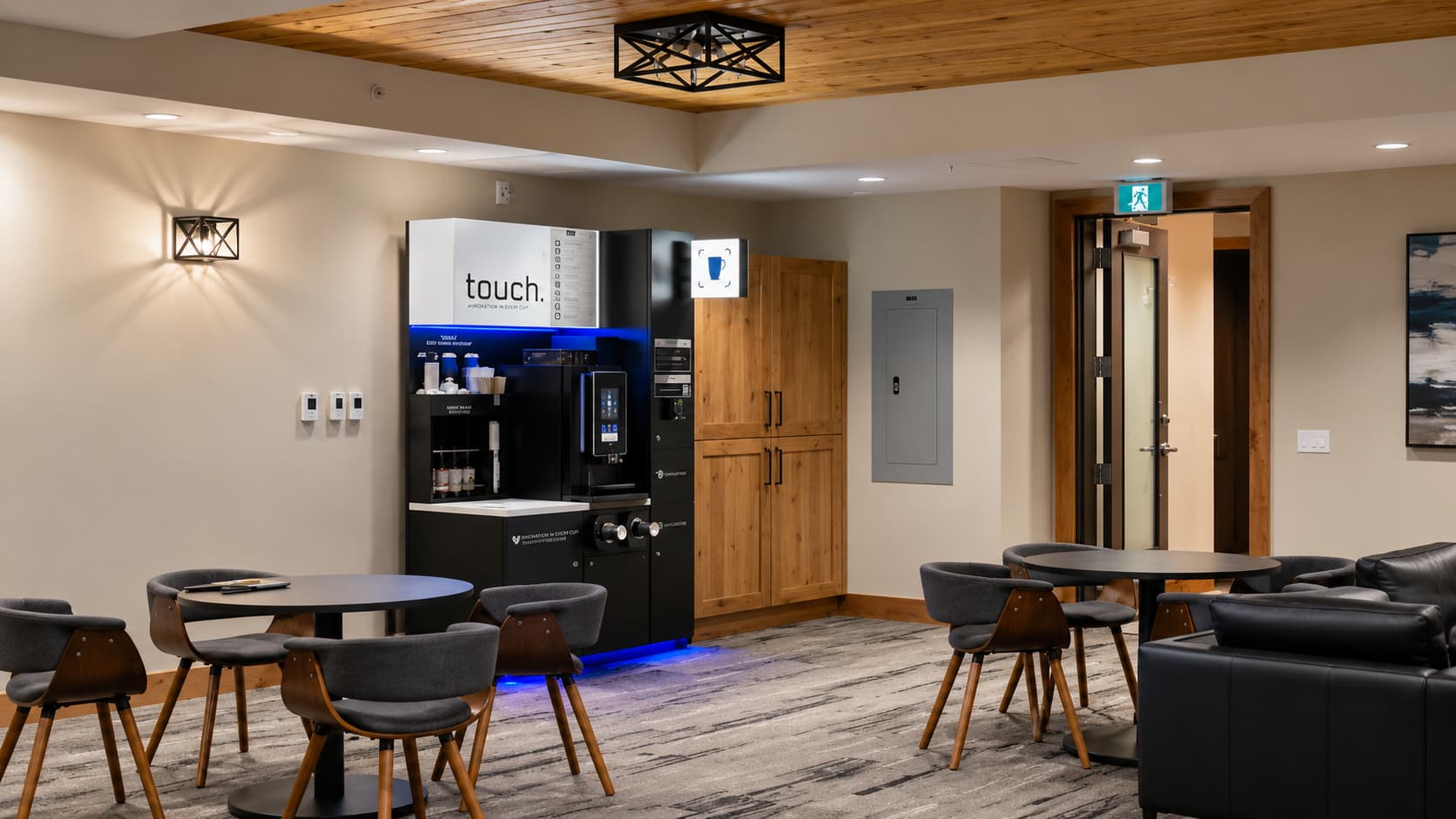
Canada is a nation of coffee drinkers — and the data backs this up unequivocally. According to the Coffee Association of Canada's 2025 Canadian Coffee Drinking Trends study, 71% of Canadians reported drinking a coffee beverage the previous day. Coffee is not just Canada's most popular hot drink — it consistently outranks even tap water in daily consumption. For serious investors, that is not a trivial statistic. It represents a massive, stable, and repeating demand curve that does not fluctuate with economic sentiment.
The question for investors in 2026 is not whether coffee is a good market. It is how to access that market in the most capital-efficient, scalable, and low-labour way possible. From our experience supporting investors across Canada and the United States, the automated coffee bar model stands out as one of the most compelling answers to that question. Here is why.
The question for investors in 2026 is not whether coffee is a good market. It is how to access that market in the most capital-efficient, scalable, and low-labour way possible. From our experience supporting investors across Canada and the United States, the automated coffee bar model stands out as one of the most compelling answers to that question. Here is why.
What Semi-Passive Income Actually Means for an Investor
The term semi-passive income gets used loosely, but its meaning matters for investors making real capital decisions. Genuinely semi-passive income comes from a business or asset that generates revenue with minimal ongoing time input from the owner — not zero input, but an amount that is sustainable alongside other professional or personal commitments.
Most so-called passive income opportunities fail this test in practice. Rental properties require tenant management, maintenance coordination, and legal administration. Stock portfolios require monitoring and rebalancing. E-commerce operations require inventory, fulfillment, and customer service. Each of these demands requires either substantial time or substantial delegation costs, or both.
An automated coffee bar operates differently. The machine handles brewing, cleaning cycles, payment processing, and customer interaction autonomously. The owner's role is limited to restocking and occasional maintenance checks — tasks that total approximately 20 minutes per day per unit. The rest of the time, the asset generates revenue independently. That is the definition of semi-passive income working as intended.
Most so-called passive income opportunities fail this test in practice. Rental properties require tenant management, maintenance coordination, and legal administration. Stock portfolios require monitoring and rebalancing. E-commerce operations require inventory, fulfillment, and customer service. Each of these demands requires either substantial time or substantial delegation costs, or both.
An automated coffee bar operates differently. The machine handles brewing, cleaning cycles, payment processing, and customer interaction autonomously. The owner's role is limited to restocking and occasional maintenance checks — tasks that total approximately 20 minutes per day per unit. The rest of the time, the asset generates revenue independently. That is the definition of semi-passive income working as intended.
Why Canada Is Particularly Well-Positioned in 2026
Several converging factors make the automated coffee bar opportunity especially strong in Canada, specifically right now.
1. Coffee Demand Is Structurally Resilient
According to the Coffee Association of Canada, coffee is more popular in Canada than tap water. Canadians consume an average of 2.7 cups per day, and the market is growing at a CAGR of 4.9% through 2032, according to industry projections. Even under economic pressure in 2025, the CAC reported no decline in daily coffee consumption — only a shift in where and how Canadians buy it. Demand at convenient, accessible locations remains constant.
2. The Smart Vending Sector Is Expanding Rapidly
The global intelligent vending machine market was valued at USD $13.39 billion in 2026 and is projected to reach USD $53.11 billion by 2034 at an 18.8% CAGR, according to Fortune Business Insights. North America accounts for 28.3% of global revenue in this segment and is growing consistently. The infrastructure, consumer acceptance of contactless payments, and density of suitable placement venues in Canadian cities make this one of the most accessible growth markets for investors entering now.
3. Labour Shortages Are Reshaping Commercial Hospitality
The 2026 TouchBistro Canadian State of Restaurants Report found that 79% of Canadian restaurant operators report ongoing staffing gaps. Immigration policy tightening has reduced the pool of temporary workers that the hospitality industry historically relied upon. This environment is actively pushing institutions — hospitals, universities, office buildings, government facilities — toward automated beverage solutions. For automated coffee bar operators, this is not a headwind. It is a tailwind that is opening placement opportunities that did not exist three years ago.
4. Return-to-Office Is Restoring High-Traffic Venue Density
After years of hybrid work disruption, major Canadian employers have progressively mandated return-to-office schedules through 2025 and 2026. The TouchBistro report noted customer traffic in office-adjacent food and beverage venues increased by an average of 34% year-over-year. Office buildings, corporate campuses, and the hospitals, gyms, and transit hubs surrounding urban business districts are all seeing stronger and more predictable foot traffic — precisely the conditions that drive automated coffee bar revenue.
1. Coffee Demand Is Structurally Resilient
According to the Coffee Association of Canada, coffee is more popular in Canada than tap water. Canadians consume an average of 2.7 cups per day, and the market is growing at a CAGR of 4.9% through 2032, according to industry projections. Even under economic pressure in 2025, the CAC reported no decline in daily coffee consumption — only a shift in where and how Canadians buy it. Demand at convenient, accessible locations remains constant.
2. The Smart Vending Sector Is Expanding Rapidly
The global intelligent vending machine market was valued at USD $13.39 billion in 2026 and is projected to reach USD $53.11 billion by 2034 at an 18.8% CAGR, according to Fortune Business Insights. North America accounts for 28.3% of global revenue in this segment and is growing consistently. The infrastructure, consumer acceptance of contactless payments, and density of suitable placement venues in Canadian cities make this one of the most accessible growth markets for investors entering now.
3. Labour Shortages Are Reshaping Commercial Hospitality
The 2026 TouchBistro Canadian State of Restaurants Report found that 79% of Canadian restaurant operators report ongoing staffing gaps. Immigration policy tightening has reduced the pool of temporary workers that the hospitality industry historically relied upon. This environment is actively pushing institutions — hospitals, universities, office buildings, government facilities — toward automated beverage solutions. For automated coffee bar operators, this is not a headwind. It is a tailwind that is opening placement opportunities that did not exist three years ago.
4. Return-to-Office Is Restoring High-Traffic Venue Density
After years of hybrid work disruption, major Canadian employers have progressively mandated return-to-office schedules through 2025 and 2026. The TouchBistro report noted customer traffic in office-adjacent food and beverage venues increased by an average of 34% year-over-year. Office buildings, corporate campuses, and the hospitals, gyms, and transit hubs surrounding urban business districts are all seeing stronger and more predictable foot traffic — precisely the conditions that drive automated coffee bar revenue.
The Financial Case: Numbers Every Investor Should Know
The semi-passive income case for an automated coffee bar is grounded in a straightforward and transparent financial structure. Understanding the unit economics is the starting point for any serious evaluation.
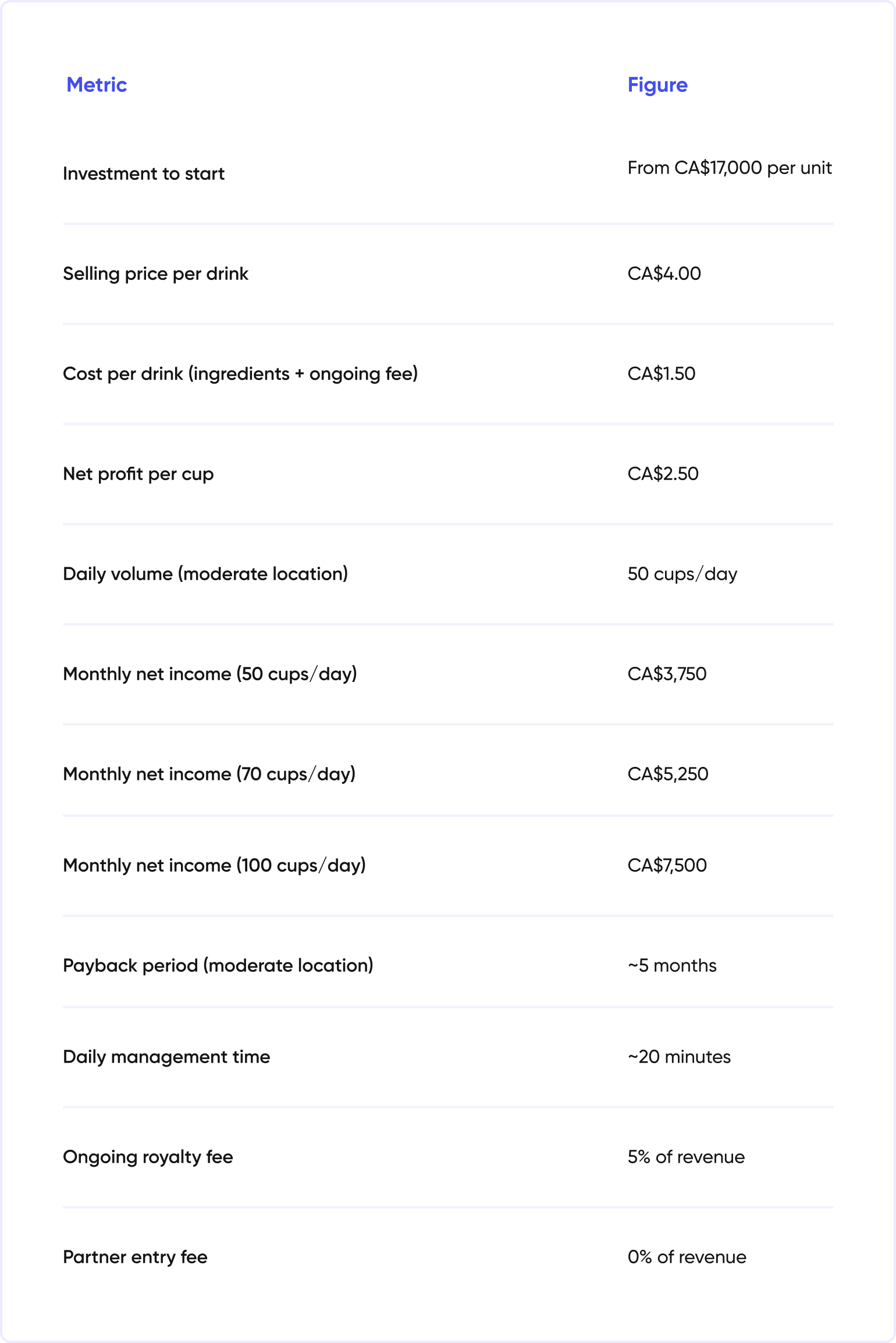
These are not projections built on best-case assumptions. The selling price, cost per cup, and profit per cup figures come directly from the Touch Coffee Smart Bar model, which has been deployed across 236 locations in Canada and 73 locations in the United States. The revenue figures above reflect real operational benchmarks, not theoretical models.
For a detailed breakdown of how revenue per unit compares across different venue types — hospitals, universities, offices, shopping malls — see our analysis of smart coffee kiosk revenue per location
For a detailed breakdown of how revenue per unit compares across different venue types — hospitals, universities, offices, shopping malls — see our analysis of smart coffee kiosk revenue per location
What Makes This Model Genuinely Semi-Passive
Understanding the operational structure is as important as understanding the financial structure. The semi-passive income label only holds if the operational demands are genuinely minimal. In the case of an automated coffee bar, several design elements combine to make that true.
Remote Monitoring via App
Every Touch Coffee Smart Bar unit is connected to a centralized management application. Investors can monitor real-time sales data, inventory levels, revenue performance, and machine diagnostics from any smartphone or laptop — without being physically present. When a unit needs restocking or flags a maintenance alert, the owner is notified instantly. This remote visibility enables one investor to manage multiple units across different locations without proportionally increasing their time commitment.
Automated Cleaning and Maintenance Cycles
The machine handles its own cleaning cycles automatically. There is no barista performing end-of-shift cleaning routines, no manager coordinating maintenance schedules, and no operational downtime during business hours. The owner's on-site time is limited to restocking ingredients — a task that takes approximately 20 minutes and can be scheduled flexibly around any other professional commitment.
Contactless Payment Processing
All transactions are processed through the Nayax payment terminal, which supports card, NFC, Apple Pay, Google Pay, and QR code payments. Revenue is collected and tracked automatically with no cash handling, no end-of-day reconciliation, and no payment disputes to manage. Cashless payment integration has been shown to increase average transaction values by up to 37% in unattended retail settings by reducing abandoned purchases.
No Staffing, No HR, No Payroll
The most time-consuming aspect of most businesses — managing people — simply does not exist in this model. There are no shifts to schedule, no sick days to cover, no training to conduct, no performance reviews to hold, and no CPP or EI remittances to process. For investors whose time is their most constrained resource, the absence of any staff management is a structural advantage that compounds over time.
This is precisely why serious investors researching semi-passive coffee business ideas consistently identify the automated coffee bar model as the most operationally efficient option in the food and beverage space.
Remote Monitoring via App
Every Touch Coffee Smart Bar unit is connected to a centralized management application. Investors can monitor real-time sales data, inventory levels, revenue performance, and machine diagnostics from any smartphone or laptop — without being physically present. When a unit needs restocking or flags a maintenance alert, the owner is notified instantly. This remote visibility enables one investor to manage multiple units across different locations without proportionally increasing their time commitment.
Automated Cleaning and Maintenance Cycles
The machine handles its own cleaning cycles automatically. There is no barista performing end-of-shift cleaning routines, no manager coordinating maintenance schedules, and no operational downtime during business hours. The owner's on-site time is limited to restocking ingredients — a task that takes approximately 20 minutes and can be scheduled flexibly around any other professional commitment.
Contactless Payment Processing
All transactions are processed through the Nayax payment terminal, which supports card, NFC, Apple Pay, Google Pay, and QR code payments. Revenue is collected and tracked automatically with no cash handling, no end-of-day reconciliation, and no payment disputes to manage. Cashless payment integration has been shown to increase average transaction values by up to 37% in unattended retail settings by reducing abandoned purchases.
No Staffing, No HR, No Payroll
The most time-consuming aspect of most businesses — managing people — simply does not exist in this model. There are no shifts to schedule, no sick days to cover, no training to conduct, no performance reviews to hold, and no CPP or EI remittances to process. For investors whose time is their most constrained resource, the absence of any staff management is a structural advantage that compounds over time.
This is precisely why serious investors researching semi-passive coffee business ideas consistently identify the automated coffee bar model as the most operationally efficient option in the food and beverage space.
Scalability: The Multiplier Effect That Changes the Math
One of the most compelling aspects of the automated coffee bar model is not the performance of a single unit — it is how the model scales. Each additional unit added to an investor's portfolio follows the same operational template as the first, which means growth in revenue does not require proportional growth in time or management complexity.
Consider what scaling looks like in practice:
Consider what scaling looks like in practice:
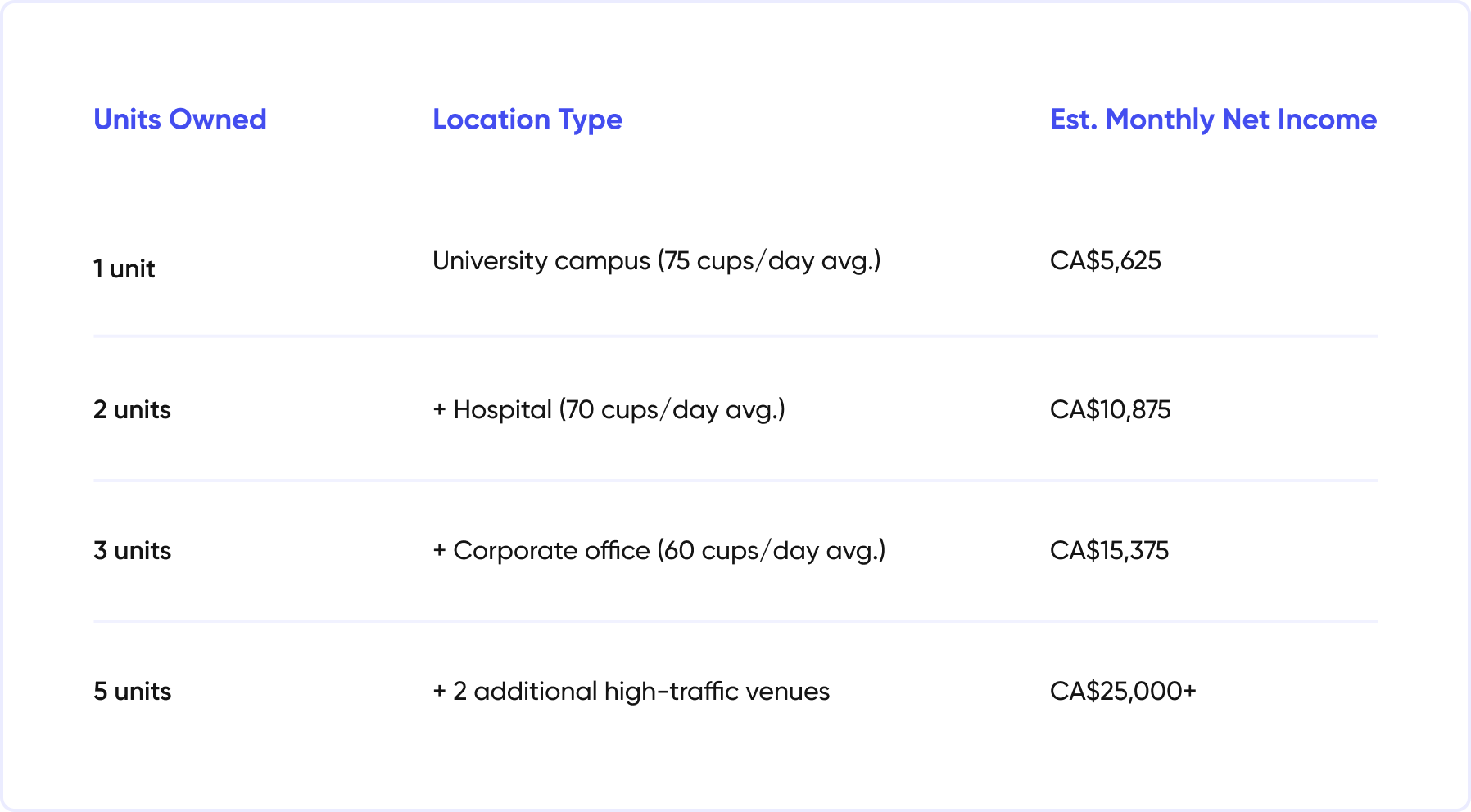
Each unit requires the same ~20 minutes of daily attention. Five units require approximately 100 minutes per day — less than two hours — to service a portfolio generating over CA$25,000 per month in net income. That ratio of time to return is what investors mean when they talk about genuine scalability.
From our experience working with Touch Coffee partners, investors regularly expand from one to three or more units within 12–18 months, using revenue from the first unit to fund the next. This reinvestment strategy is covered in depth in our guide on building a multi-unit automated coffee bar portfolio
From our experience working with Touch Coffee partners, investors regularly expand from one to three or more units within 12–18 months, using revenue from the first unit to fund the next. This reinvestment strategy is covered in depth in our guide on building a multi-unit automated coffee bar portfolio
Where Automated Coffee Bars Perform Best in Canada
Location selection is the single highest-leverage decision in this business model. The right venue converts foot traffic into consistent revenue. From operational data across hundreds of Canadian placements, the highest-performing venue categories in 2026 are:
Touch Coffee's location support team assists investors in identifying, approaching, and securing venue agreements — including reference materials, success stories from existing placements like Okanagan College, Kelowna General Hospital, Ontario Tech University, and the City of Kelowna. For a full breakdown of venue selection strategy, see our guide on the best locations for starting a smart coffee bar
- Universities and college campuses — consistent student and staff foot traffic, long operating hours, strong daily repeat behaviour
- Hospitals and medical centres — 24/7 staff demand, underserved evening and night-shift beverage access, institutional placement credibility
- Corporate office buildings — dense weekday foot traffic, employee satisfaction value, return-to-office momentum driving demand
- Shopping malls — high-volume footfall, extended operating hours, strong impulse purchase environment
- Recreation centres and gyms — peak morning and evening traffic, health-conscious demand for premium beverage options
- Government buildings and municipal facilities — stable institutional foot traffic, long-term placement security
Touch Coffee's location support team assists investors in identifying, approaching, and securing venue agreements — including reference materials, success stories from existing placements like Okanagan College, Kelowna General Hospital, Ontario Tech University, and the City of Kelowna. For a full breakdown of venue selection strategy, see our guide on the best locations for starting a smart coffee bar
Who This Business Model Is Built For
The automated coffee bar is not the right fit for every type of investor — and being clear about that matters. This model is designed specifically for:
It is not designed for operators who want to build a brand identity in hospitality, engage daily with customers, or develop a team-led service culture. The automated coffee bar is an investment asset that generates recurring income — not a lifestyle business or a customer-facing hospitality operation.
For investors evaluating how this model fits within a broader portfolio strategy, our overview of the unattended retail and automated food and beverage sector provides useful context on how these businesses are increasingly being treated as asset classes rather than traditional owner-operated ventures.
- Professionals with existing careers or businesses who want to build income streams that do not consume their working hours
- Entrepreneurs who want a scalable, asset-based business with a defined, transparent cost structure
- Investors seeking alternatives to real estate that offer faster payback periods and lower entry costs
- Business owners looking to diversify revenue across multiple income-generating assets
- Individuals who want a business with a clear, supported partner roadmap rather than building from scratch
It is not designed for operators who want to build a brand identity in hospitality, engage daily with customers, or develop a team-led service culture. The automated coffee bar is an investment asset that generates recurring income — not a lifestyle business or a customer-facing hospitality operation.
For investors evaluating how this model fits within a broader portfolio strategy, our overview of the unattended retail and automated food and beverage sector provides useful context on how these businesses are increasingly being treated as asset classes rather than traditional owner-operated ventures.
Start Evaluating Your Opportunity
Canada's coffee market is growing. The smart vending sector is expanding at nearly 19% CAGR. Staffing pressures are pushing institutions toward automated solutions. Return-to-office mandates are restoring commercial foot traffic. The conditions for an automated coffee bar investment are as favourable in 2026 as they have ever been.
Touch Coffee offers a fully supported entry point into this market — from the CA$17,000 starting investment and a payback period of approximately five months, through to location assistance, partner dashboard access, and ongoing operational support.
Explore the Touch Coffee Smart Bar opportunity today and request a conversation with the team to discuss your target market, preferred locations, and expected timeline to first revenue.
Touch Coffee offers a fully supported entry point into this market — from the CA$17,000 starting investment and a payback period of approximately five months, through to location assistance, partner dashboard access, and ongoing operational support.
Explore the Touch Coffee Smart Bar opportunity today and request a conversation with the team to discuss your target market, preferred locations, and expected timeline to first revenue.