Automated Coffee Bar vs. Rental Property: A Scenario-Based ROI Comparison for Canadian Investors in 2026
A Toronto rental property in 2026 costs roughly CA$545,000 to purchase and delivers a gross rental yield of around 5.9%, with cash-on-cash returns that are frequently negative once mortgage payments are included, according to 2026 market data from Place Real Estate. A Touch Coffee Smart Bar has a stated entry cost of CA$17,000. What an individual unit actually returns depends heavily on cup volume, location, and operating costs that are not all fully disclosed — which is exactly why this comparison uses ranges and scenarios rather than a single confident number.
This blog is intended for investors comparing small business ideas against traditional real estate as an asset class. It is written and published by Touch Coffee, so it should be read as vendor-published content, not independent financial research. Every figure below is lab
This blog is intended for investors comparing small business ideas against traditional real estate as an asset class. It is written and published by Touch Coffee, so it should be read as vendor-published content, not independent financial research. Every figure below is lab
Per-Cup Economics: What the Numbers Actually Show
Touch Coffee states a sale price of CA$4.00 per cup and an ingredient cost of CA$1.50 per cup. That ingredient cost is 37.5% of the sale price — worth stating precisely, since marketing materials sometimes describe ingredient costs in the 20–25% range, which does not match this figure. A 5% royalty applies on top of ingredient cost. Card and contactless payment processing — a real cost in any unattended retail business — typically runs 2.5–3% of transaction value; this article uses 2.8% as a working estimate.
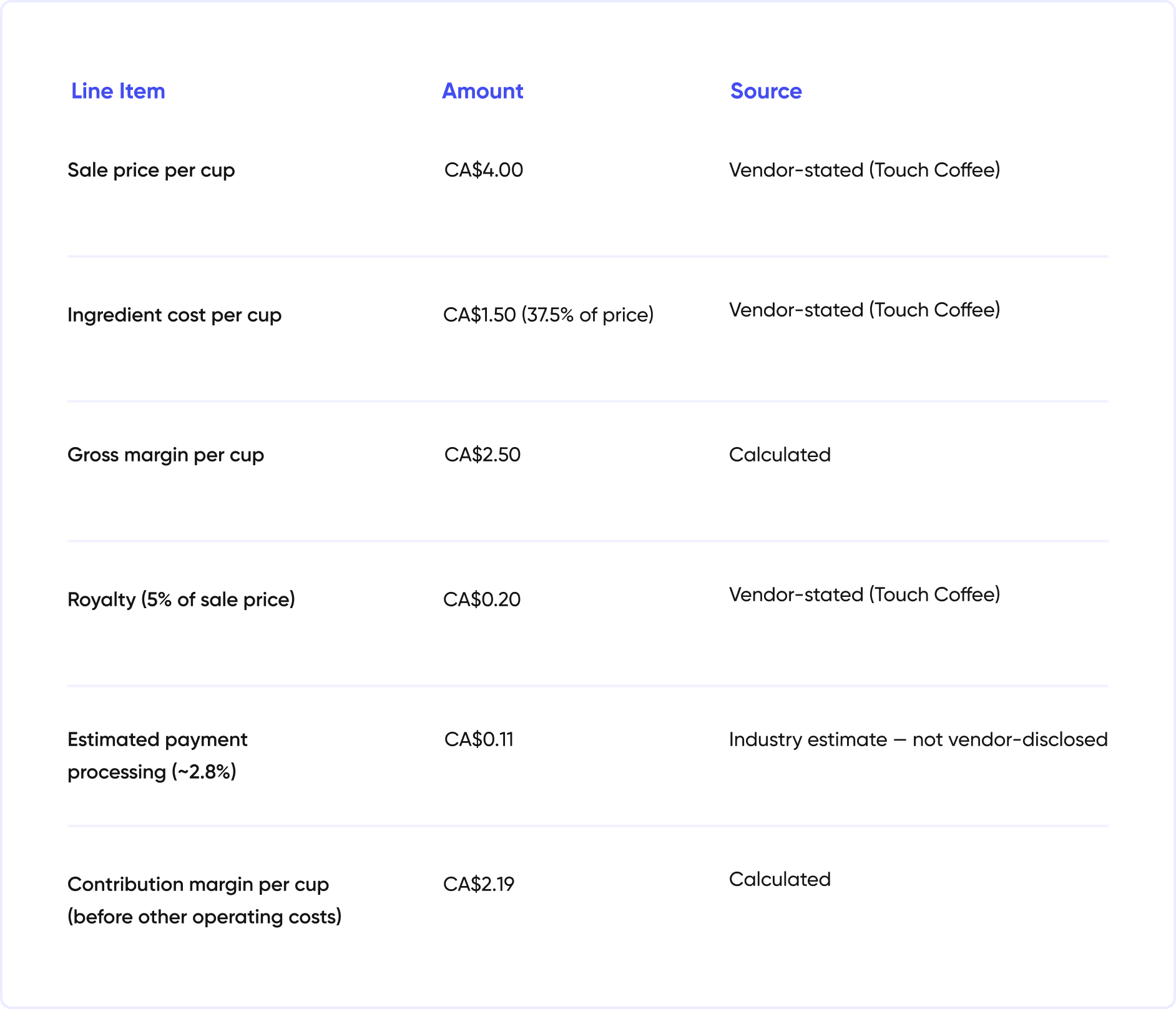
"Contribution margin" — not "net profit" — is the accurate term for CA$2.19 per cup. It still excludes insurance, licensing, machine maintenance and repair reserves, spoilage, any venue compensation arrangement, and the value of the owner's own time. For a full breakdown of the technology and payment infrastructure behind these per-cup economics, see our overview of the Touch Coffee Smart Bar technology.
Revenue Scenarios: Conservative, Moderate, and Strong Cup Volume
Rather than presenting a single "typical" outcome, this comparison uses four volume scenarios. None of these are guaranteed — actual results depend on location, foot traffic, and factors outside any single projection. For a venue-by-venue breakdown of what cup volumes look like in practice, see our analysis of smart coffee kiosk revenue per location
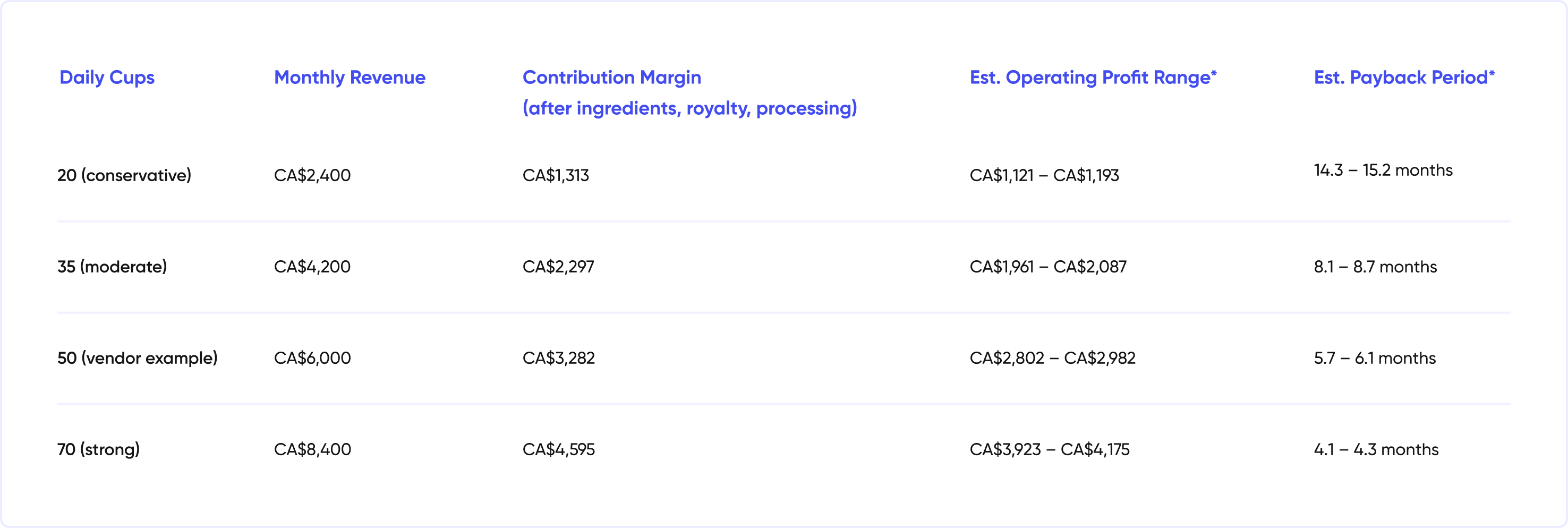
*Operating profit range assumes an estimated 5–8% of revenue reserved for insurance, licensing, maintenance, repairs, and spoilage — a working estimate, not a Touch Coffee-disclosed figure. It excludes the owner's time value and any income tax. At 50 cups per day — the figure most commonly referenced in Touch Coffee's own marketing — the estimated payback period is roughly 5.7 to 6.1 months, not a guaranteed four to five months. Cup volume is driven heavily by location — our guide on choosing the right location for your coffee bar covers how site selection affects which of these scenarios is realistic for a given placement.
Real Estate Entry Cost: Corrected Toronto Closing Cost Estimate
A CA$545,000 Toronto property purchase triggers both Ontario provincial land transfer tax and City of Toronto municipal land transfer tax — two separate taxes that are often understated when only one is mentioned.
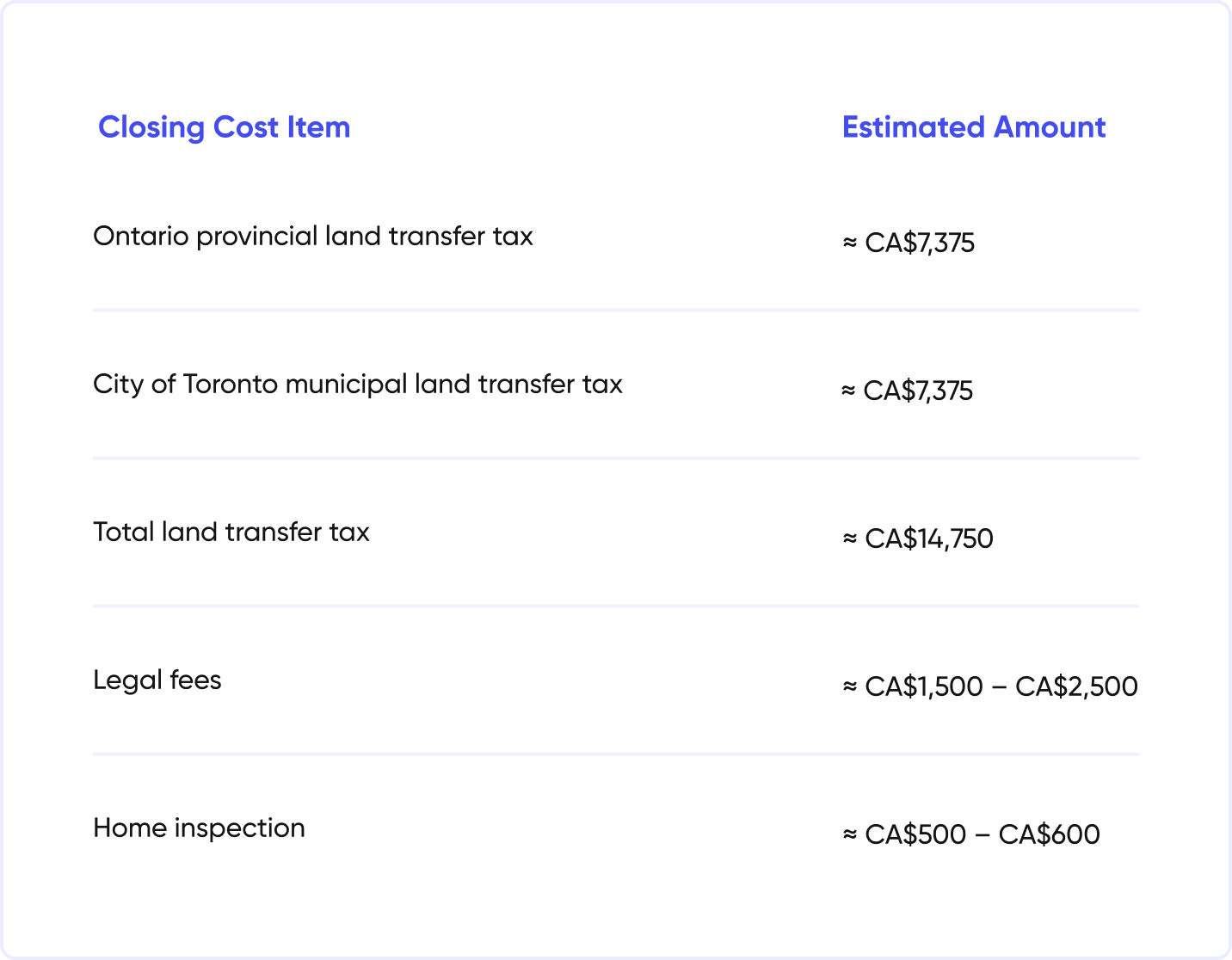
This is calculated using current published Ontario and Toronto land transfer tax brackets, applied to a CA$545,000 purchase price. First-time homebuyer rebates may reduce this for a principal residence purchase, but do not typically apply to an investment property purchase — which is the scenario relevant to this comparison. On a percentage basis, closing costs alone represent roughly 3.2% of the purchase price before any mortgage down payment is factored in. For investors specifically weighing financing structures, our guide on financing your first automated coffee bar covers funding options on the coffee bar side of this comparison.
Comparing Both Assets on Equal Terms: Four Financial Measures
A fair comparison cannot mix a leveraged, appreciating asset against an unleveraged, depreciating one using a single number. Here is how both should be measured across four distinct metrics.
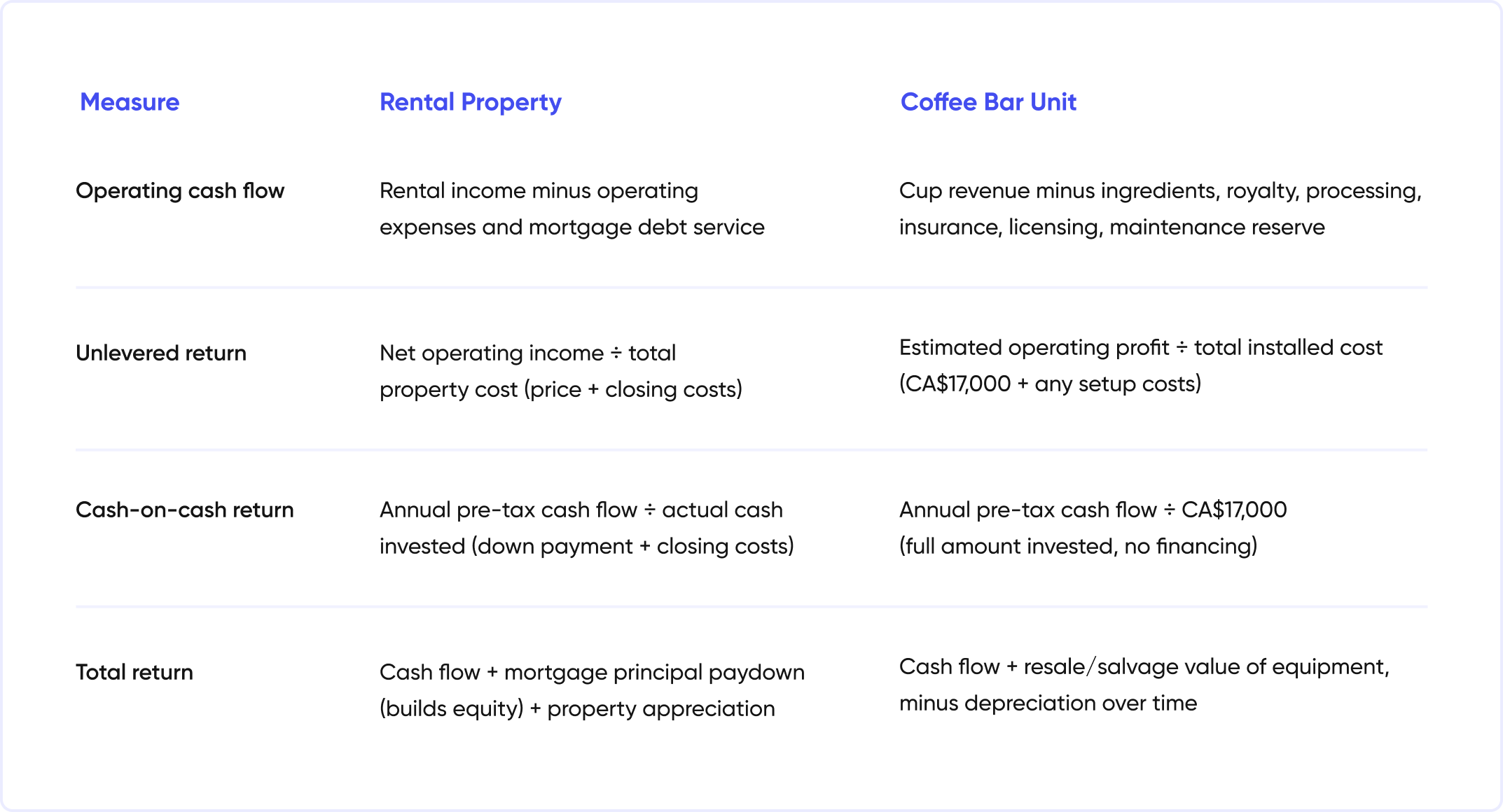
Two structural differences matter here and are easy to overlook. First, a mortgage payment on a rental property is partly principal repayment — money that builds the owner's equity rather than disappearing as an expense. A coffee bar machine, by contrast, is equipment that depreciates over its useful life. Second, real estate cash-on-cash return is typically calculated on the cash actually invested — the down payment and closing costs, not the full property price — because the rest is financed. The coffee bar has no financing, so its cash-on-cash return and its full-price return are the same number.
Return Comparison: Using Ranges, Not Single Numbers
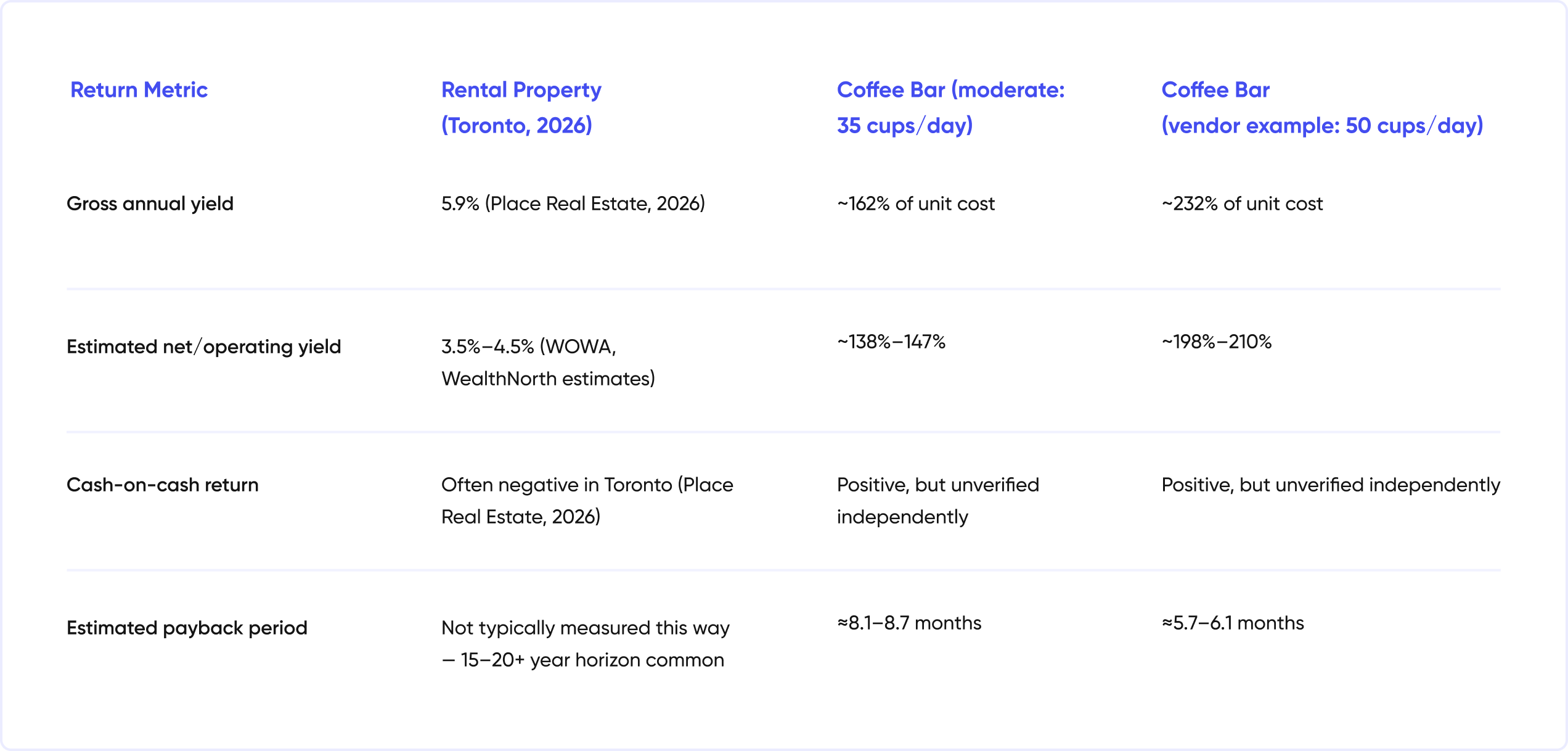
The percentage gap between these two asset classes is large under either scenario — that much is arithmetically true given the disclosed inputs. What is not independently verified is whether 35 or 50 cups per day is realistic for any specific location, or whether the estimated cost reserve of 5–8% of revenue is accurate for a given venue. Our breakdown of key operational challenges in an automated coffee business covers some of the variables — like machine downtime and location performance — that can move actual results within or outside these ranges.
Liquidity and Flexibility
Real estate is among the least liquid major asset classes available to Canadian investors. Selling typically involves realtor commissions (commonly 4–5%), legal fees, and a sale timeline running from weeks to several months.
A coffee bar unit is a physical, movable asset. If a location underperforms, Touch Coffee describes the ability to relocate a unit to a different venue — an option a rental property does not have. What is not independently documented is the resale market for used automated coffee bar units, actual resale values after depreciation, or how quickly a unit can realistically be relocated and re-approved at a new venue. Speak with the Touch Coffee team directly for data on unit relocations, resale transactions, and typical downtime during a move before relying on liquidity as a deciding factor.
A coffee bar unit is a physical, movable asset. If a location underperforms, Touch Coffee describes the ability to relocate a unit to a different venue — an option a rental property does not have. What is not independently documented is the resale market for used automated coffee bar units, actual resale values after depreciation, or how quickly a unit can realistically be relocated and re-approved at a new venue. Speak with the Touch Coffee team directly for data on unit relocations, resale transactions, and typical downtime during a move before relying on liquidity as a deciding factor.
Risk Factors on Both Sides
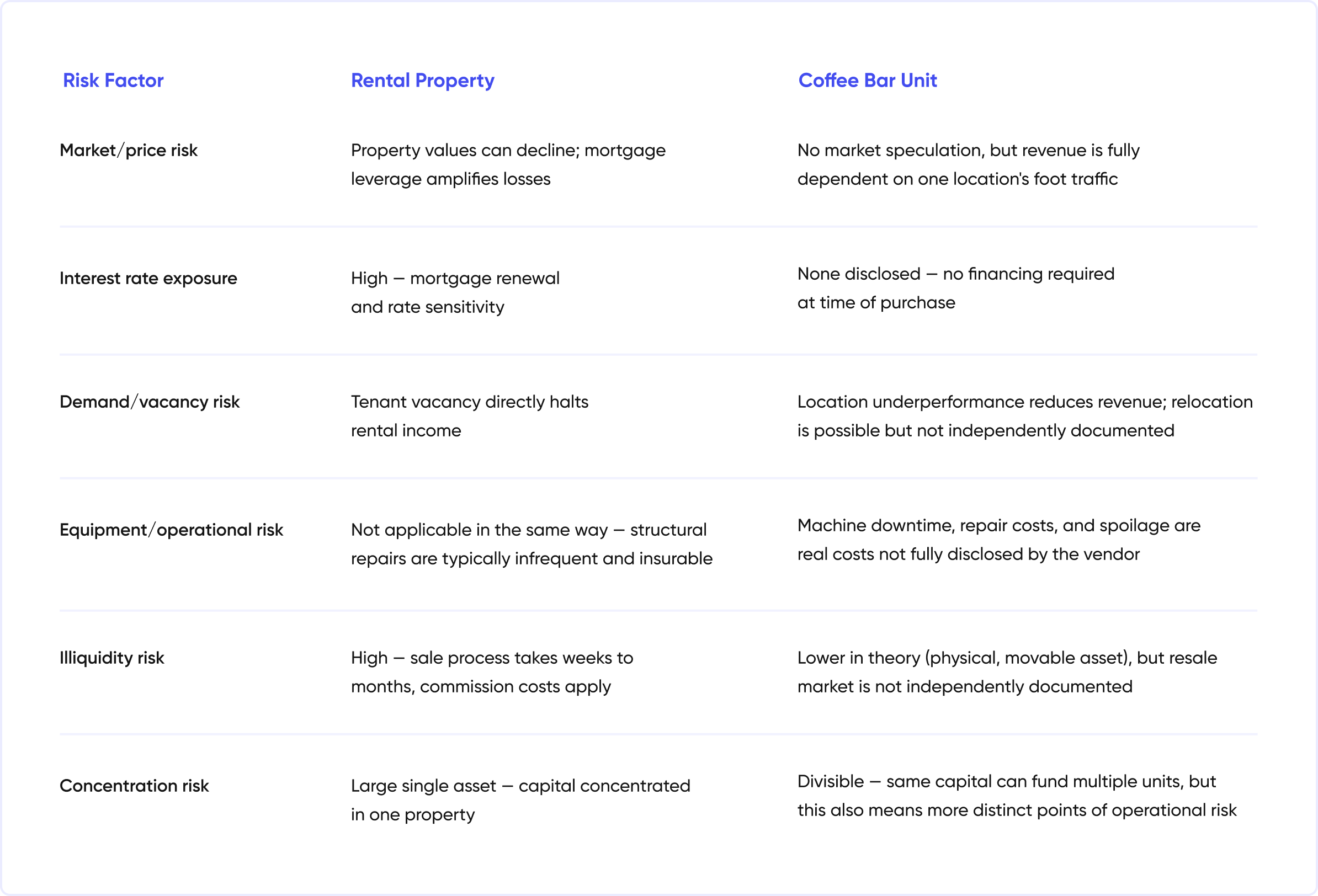
For investors specifically weighing operational risk on the coffee bar side, our guide on understanding the risks of an automated coffee business and how to mitigate them goes into more depth on machine uptime, warranty coverage, and location dependency.
Where Real Estate Has Structural Advantages
A transparent comparison has to name where the traditional asset class outperforms — clearly and without overstating the coffee bar side to compensate.
These advantages are real and not replicated by the coffee bar model. They are also not mutually exclusive — some investors hold both asset types, using real estate for long-term equity building and a coffee bar unit for nearer-term cash flow.
- Leverage: Mortgage financing lets an investor control a large asset with a fraction of its value in cash — this amplifies both gains and losses, and is unavailable in the same form for a CA$17,000 equipment purchase
- Long-term appreciation: Canadian real estate has historically delivered 5–10% total annual returns including appreciation, per 2025 data from jenjewell.ca — a wealth-building mechanism distinct from monthly operating income
- Equity building through principal repayment: A portion of every mortgage payment reduces loan principal and builds the owner's equity — money that is not "spent," unlike most coffee bar operating costs
- Established tax framework: Under CRA rules, reasonable expenses incurred to earn rental income — including qualifying mortgage interest — are generally deductible. Note that mortgage principal repayment is not deductible, and the principal-residence capital gains exemption applies only when a property qualifies and is designated as a principal residence; renting out a property can affect eligibility for that exemption. Consult a tax professional for your specific situation
These advantages are real and not replicated by the coffee bar model. They are also not mutually exclusive — some investors hold both asset types, using real estate for long-term equity building and a coffee bar unit for nearer-term cash flow.
What to Verify Before You Decide — Either Way
Neither side of this comparison should be taken at face value. Before committing capital to either asset, an investor should independently verify:
For a coffee bar unit:
For a rental property:
For a coffee bar unit:
- Full itemized costs — insurance, licensing, maintenance/repair reserves, and any venue compensation arrangement, requested directly from Touch Coffee
- Actual, independently verifiable performance data from existing partner locations — not vendor-selected examples
- Documented resale/relocation process, typical downtime, and secondary market value for used units
- The complete legal agreement, including any disclaimers on earnings representations
For a rental property:
- Current mortgage rates, stress-test qualification, and realistic vacancy assumptions for the specific neighbourhood
- A licensed mortgage broker's assessment of actual cash-on-cash return after all financing costs
- A tax professional's review of deductible expenses and any principal-residence exemption implications
- Independent property inspection and realistic maintenance/capital expenditure reserves
Talk to Touch Coffee — With Your Own Numbers
This comparison is published by Touch Coffee to help investors understand how the two asset classes are structured differently — not to present a guaranteed outcome for either. The real estate figures come from independent 2026 Canadian market sources, cited throughout. The coffee bar figures combine Touch Coffee's own disclosed pricing with independent estimates for costs the company has not itemized publicly — clearly marked as such above.
If you are evaluating a business for sale or online business for sale alongside real estate, contact Touch Coffee directly and ask for complete, itemized cost data for your specific target location — including insurance, licensing, and maintenance figures not covered in this article.
A realistic projection depends on numbers specific to your market, not a general comparison. Start that conversation with the Touch Coffee team today and get the itemized figures for your target city and venue type.
Start with Touch Coffee Today →
If you are evaluating a business for sale or online business for sale alongside real estate, contact Touch Coffee directly and ask for complete, itemized cost data for your specific target location — including insurance, licensing, and maintenance figures not covered in this article.
A realistic projection depends on numbers specific to your market, not a general comparison. Start that conversation with the Touch Coffee team today and get the itemized figures for your target city and venue type.
Start with Touch Coffee Today →